
Connectivity that never touches the public internet
Private Layer 2 network between your infrastructure
Dedicated 100G and 400G waves across our European backbone, plus FDC-owned dark fiber between data centers in five North American hubs
Get a QuoteFeatures
Why teams choose FDC for Private Layer 2
Waves on FDC's European backbone, not resold from a carrier
FDC-owned dark fiber inside five North American metros
One operator end to end. No stitched cross-connects between providers
Ethernet transport in EPL or EVPL style
Your VLANs, your addressing, transparent to your equipment
One broadcast domain across your sites

Dark fiber spans Equinix and CoreSite facilities in the same city
Move between data center campuses without locking to one operator
Two buildings behave as if they shared a switch
Direct point-to-point path. Fewer hops than public-internet transit, lower and more predictable latency
Dedicated capacity end to end. No contention with other customers' traffic, no queuing at congested peering points
Low jitter for cluster quorum, synchronous replication, and latency-sensitive database tiers
Use cases
Built for east-west traffic between sites
Bridge nodes in different cities onto one Layer 2 segment. Heartbeats, quorum, and failover behave as if the cluster sat in one rack
Move backups and replicas across metros without public IPs, transit costs, or NAT in the path
Link two FDC PoPs, or two buildings in the same metro, on one fabric. One contract, one set of credentials
Extend an existing private network across cities without rebuilding routing, addressing, or firewall policy
One private path between your sites
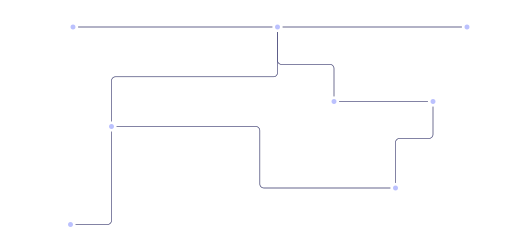
Dedicated waves in Europe and DC-to-DC dark fiber in North America.
European metro waves
100G and 400G capacity. Sub-rate options on request.
100G/400G Wave
London
Amsterdam
Amsterdam
Frankfurt
Amsterdam
Warsaw
Paris
Amsterdam
Frankfurt
Prague
Prague
Vienna
Vienna
Paris
Paris
Madrid
North American dark fiber
DC-to-DC L2 within the metro. Additional locations, routes & capacities on request.
FDC dark fiber
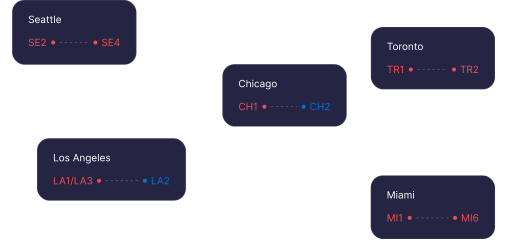
Seattle
Equinix SE2
Equinix SE4
Chicago
Equinix CH1
Coresite CH2
Toronto
Equinix TR1
Equinix TR2
Los Angeles
Equinix LA1/LA3
Coresite LA2
Miami
Equinix MI1
Equinix MI6
FAQ
Frequently asked questions
Yes. Private Layer 2 connects endpoints on FDC’s network, so each location needs one of either Dedicated Servers, IP transit, or Colocation with IP transit
In Europe, we carry dedicated waves between cities on our own backbone, such as London to Amsterdam. In North America, FDC-owned dark fiber links data centers within the same metro, such as Equinix CH1 to CoreSite CH2 in Chicago. You get the same result either way: one private Ethernet segment between your sites.
Layer 3 links separate networks through routing, so each site keeps its own subnet. Layer 2 extends one Ethernet segment across both sites. Your servers share a broadcast domain, keep their existing addressing, and reach each other with no router in the path. Many clustering tools, VRRP failover and live VM migration need that adjacency. The common Layer 3 alternative is a VPN tunnel over the public internet. That adds tunnel overhead, and latency shifts with transit routing and peering congestion. Private Layer 2 runs on dedicated capacity, so throughput and latency stay consistent.
Yes. The link is transparent to your equipment. Your VLAN tags and addressing pass through unchanged, so you don’t renumber anything at either end.
The routes above are live today. We scope other metros, facilities and capacities on request. Send us your locations and we’ll tell you what’s possible.